
PAST GRAPEVINE ARTICLES
Our Voice
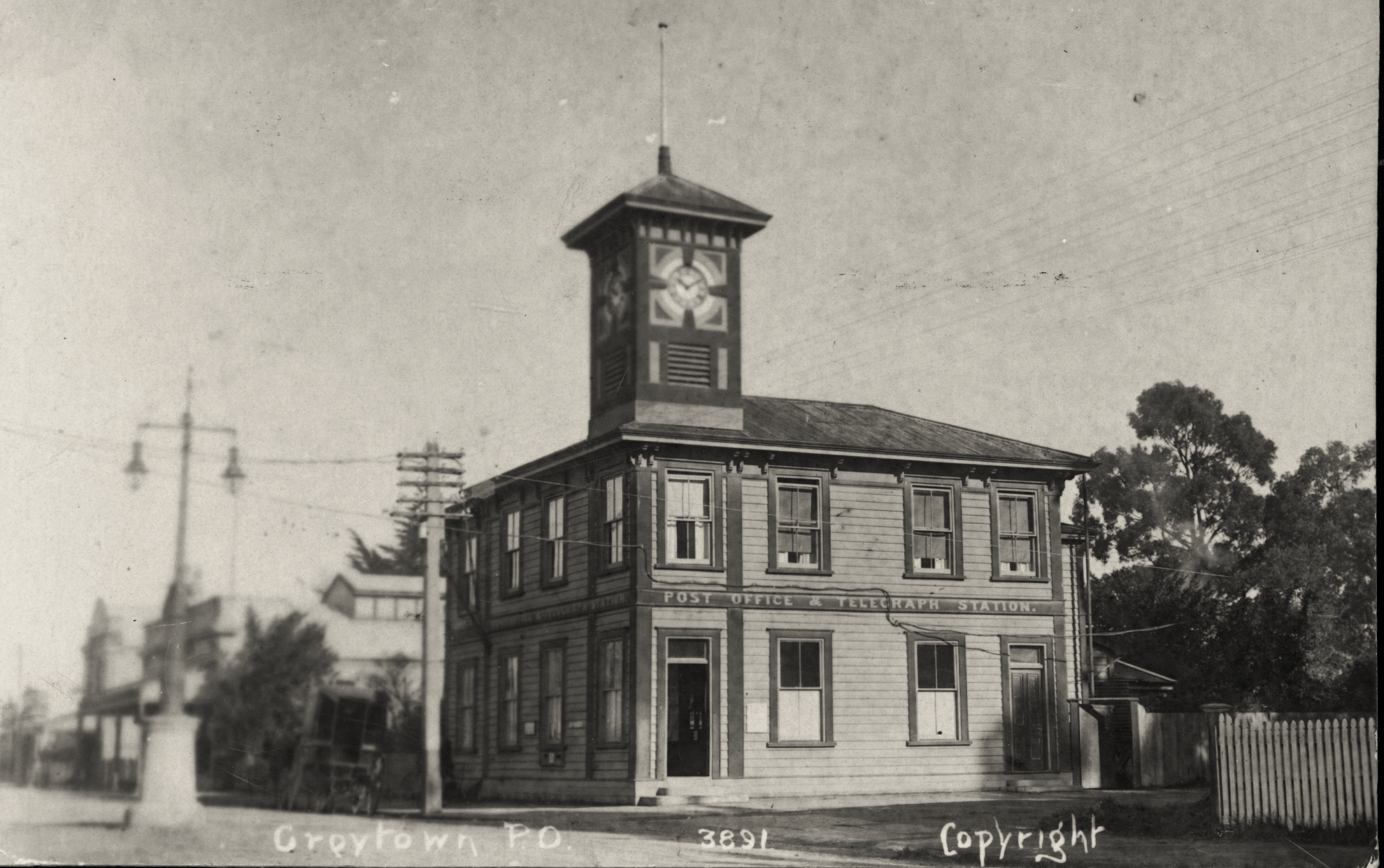
Arbor Day 2023 planting – Arbor Reserve Main Street
July 2023
Thanks to the leadership and sponsorship of the Greytown Community Board, especially Chair Louise Brown, Deputy Chair Warren Woodger and member Neil Morison, the 133rd Greytown Arbor Day successfully took place on its anniversary date of 3 July. Appropriately, the planting by Mayor Martin Connelly of a tōtara and scarlet oak was at Arbor Reserve. This green space was established in 1990, with great help from the Greytown Lions Club, to mark the centenary of Greytown’s Arbor Day.
This year’s planting started with a karakia led by Warren Maxwell of the Featherston Community Board and a teacher of Te Reo at Kuranui College. Mayor Martin, having planted the two trees, spoke of the importance of tree planting in the age of climate change and the importance of keeping the Greytown Arbor tradition active. It was a truly bi-cultural occasion. Warren’s concluding address included reference to the participation and support at earlier Arbor Days of mana whenua ariki, especially that of Major Brown/Hoani Tunuiarangi Parone and Hamuera Tamahau Mahupuku on 3 July 1890. Leanne Karaunga, Council’s Principal Advisor Māori/Pou Māori led the waiata and also made a moving karanga.
Of note too was the attendance of former Councillor, Deputy Mayor and Community Board member Mike Grey. He, alongside his late wife Kay, was a leading figure in organising the 1990 centennial celebrations.and the establishment of Arbor Reserve. Also present was Deidre Ellims, former owner of Greytown’s historic Main Street Cottage Elms Arbor, now resident in Carterton. Deidre has been attending Arbor Day events for at least 70 years.
Woolworths New Zealand Ltd Application - 134 Main Street. What next?
We understand there were over 70 submissions made to Council. Well done Greytown! Council has appointed an independent hearing commissioner, Lindsay Daysh, to consider the application and submissions. There are two hearings scheduled:
Day 1 – WBS Room Greytown Town Centre, 89 Main Street Greytown from 9.00am, 2 October 2023;
Day 2 – Kiwi Hall, 62-64 Bell Street, Featherston, Tuesday 3 October 2023 from 9 am.
The Future of Greytown’s Cricket Pavilion – Greytown Soldiers’ Memorial Park
This charming 1970s building with its attractive turret was designed for free by cricket lover and senior architect, sometime Greytown resident, the late Reg Stapleton. A Council manager recently confirmed a previous Council decision to allocate $1,000,000 dollars towards the demolition and replacement of this modern heritage building. $19,356 of that sum has currently been spent on this project.
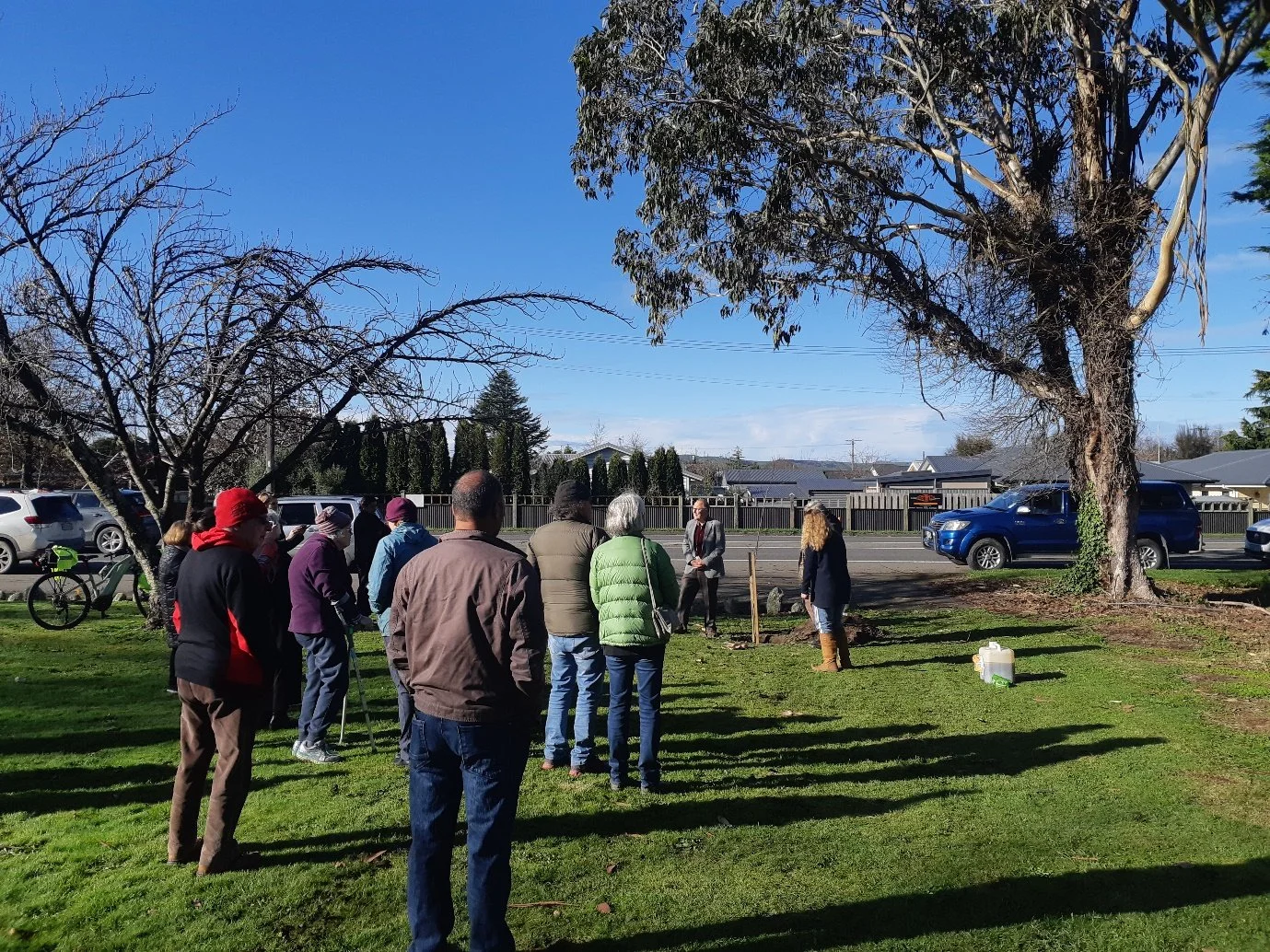
Mayor Martin Connelly (far right with Louise Brown and Warren Maxwell) speaking at the ceremony. To the left with impressive red headgear, Mike Grey. To Mike’s right with a purple jacket is Deidre Ellims.
Past Mayor of Greytown dies aged 101
Vale Richard Harding (b December 1921 – d July 2023)
August 2023
A lifetime of over a century is likely to be punctuated by achievement and fascinating history. The life of Richard Harding, Naval Commander and one-time Greytown Mayor (1975 – 1983) was just that; marked by accomplishment and colour.
Richard Harding had a significant career with the Royal Navy and the Royal New Zealand Navy both through the War and for the following two decades. Subsequently, he was a Greytown resident for over fifty years.
Richard delighted in the fact that his Commanding Officer on his first Destroyer at the outset of war, defending the English Channel, was Charles Dickens’ great grandson. Indeed, it was Peter Dickens who recommended the then-young Harding for a commission. Harding had narrowly missed being on the crew of HMS Neptune which struck a Mediterranean minefield killing 150 New Zealanders.
The sea ran deep in this man’s life. For many years, Richard Harding kept a boat in Mana and was known to occasionally make a feisty Cook Strait crossing to the Marlborough Sounds in this 28-foot (8.5 metre) craft.
Upon retirement from the RNZN, Richard Harding and his British-born wife Gabrielle moved to Greytown and was enticed to manage Tate’s Orchards to the west of Mole Street, living in a significant house on Kuratawhiti Street, which he renovated, before moving further west to a house they built on the same road. Amongst many things, Gabrielle was celebrated for breeding donkeys, although family wryly note that Richard did most of the work.
Interested, impassioned and lucidly articulate about the state of things, Richard Harding cared for the world about him. Taking great interest in the life of the town, in politics, both local and international, actively enjoying his friends (and his dogs, latterly Toby), his venerable age wasn’t an impediment to staying connected. Christ’s College of which he was an alumnus, judged him to be their longest-living old-boy at their reunion in 2020.
As Mayor, Richard oversaw the relocation of the Masonic Hall from West Street to Main Street, where it served as the town’s library. Deeming it a compromising proposal, he led a petition in opposition to the library being moved to the refurbished Town Hall, for which he had been champion and hands-on active handyman, painter and decorator.
Reflecting upon his life and the calibre of the man, a close friend observed that “it was an honour to have known him”. Richard Harding was a man who gave vigorously and generously to both his friends and his community. He argued that smiling was one of the tenets of his longevity. He is a man remembered fondly.
Dragging a decrepit steam-driven car out of the tangle of grass in a paddock, Will Holmes set to on an early project for himself which was a fastidious rebuild of the vehicle in his admirably outfitted and tooled garage. Its final notable blue livery, fully functional and accurate, was a testimony to the patience and persistence with detail that coloured Will’s life. It prefigured a yen for vintage cars, mainly the Austin marque.
Will Holmes was born in the Bay of Islands, but there was a transient childhood in early years as his father chased railway jobs around the North Island, including time in Taihape. The family hauled up finally in Spring Creek, below the rugged Wairarapa slopes of the Remutaka Hill; a junction for the steam trains that in those days laboured the inclines on what has now become the cyclists’ and walkers’ joy of the Remutaka Rail Trail. Indeed, Will’s father was to take the last ever locomotive over the hill and back to Wellington.
Rising early to clear possum traps, Will made an early living at just 12 years old selling furs to fund his ambition to be a carpenter; hand tools and a shed in the garden were the investments for a motivated lad. Following the rounds of traps, he journeyed an hour each way to Wairarapa College. Landing a Ministry of Works’ apprenticeship, he triumphantly left school for his new working life only to be turned back because the conditions of the contract were that he complete two years at secondary school. He had just eighteen months under his belt and returned, ruefully, to the classroom.
Will Holmes was a significant builder in the Greytown area. The beginnings were in a modest partnership with Graeme Rigg to form HR Builders, the company later morphed several times to become Will Holmes Ltd, Holmes Construction Group and latterly amalgamated two companies, formed previously under the Holmes brand, to become Holmes Construction New Zealand. It has been a business that has stayed in the family. Ben, Will’s nephew, is current CEO and Will’s sons previously had the reins following their father’s retirement. The generations built a company of consequence.
Will Holmes was a very significant contributor to Greytown. Four life memberships of community organisations are testimony to this. He died a life member and Patron of the Rugby Club (with a double entitlement to such an affiliation by both length of membership and honorary award). He was an ally of Cobblestones Museum, served with the Greytown Heritage Trust and maintained a lifetime membership with the Vintage Car Club.
Will died just three weeks after his beloved wife of forty years, Ruby. His first wife, Lennie, mother to his children, continues to live in Masterton. Reflecting on his father’s life, Will’s son described a man who has had an incredible way about him; a man who tangibly loved his family and community; a man who was a great conversationalist and an absolute gentleman. He was, says Andy his son, just a good bastard. Hear the utter affection and deep regard in those words.
Vale Will Holmes
Born 3 May 1937, died 10 August 2023
August 2023
Annual Address 2023 by Tā (Sir) Kim Workman
October 2023
The past is another country: they do things differently there. Or so L.P. Hartley wrote in his novel The Go Between. In te ao Māori there’s a challenge; the shared whakataukī is kia whakatōmuri te haere whakamua: ‘I walk backwards into the future with my eyes fixed on my past’. Here, the past, present and future coalesce and become intertwined, and life is experienced as a real and reflective relationship between all humanity and all history.
In the Greytown Heritage Trust Annual Address 2023, it is te ao Maori and the notion of heritage that Tā Kim Workman will explore and consider.
At one level the past, present and future are explicitly part of Tā Kim Workman’s relationship with this town. He returned to live here last year having left at 17 years old. Born in 1940, we’ll leave you to count on your fingers, the years away.
Coming back has given him a tangible appreciation of the places that are todays' heritage sites. These were the places that formed part of the village in the 1940s , and hold memories of people who were part of his early life. Alongside this, Tā Kim’s awareness of histories has heightened and he observes that we all have a different perspective about why particular sites are significant, and that when we share those perspectives, their full meaning is revealed.
Perhaps in this we begin to give histories and landscape and buildings and monuments their deserved mana? In the official list that identifies our most significant historic heritage places by Heritage New Zealand Pouhere Taonga, there’s a hefty slew in favour of Pākehā heritage.
Less than 10 percent of the list identifies Māori heritage, and around 80 percent of the list embraces buildings.
Tā Kim talks of the intertwined relationship of place and whanau of his childhood. Friday nights over a beer or two, his grandparents and six of father’s siblings, eating home-roasted peanuts and reshaping the politics of the nation. Meanwhile, he could roam the town freely, seemingly known by everyone; dropping in on uncles, aunties, cousins; the rituals of an unfettered childhood.
Greytown was a village more rural, more bucolic than it perhaps is now. At the rear of his family home was a large barn-like building that Tā Kim’s father had built. The red-stained timber had come from the Aotea meeting house at Pāpāwai Pā, after it blew down in a 1934 gale. Aotea had been built in the 1890s to house the Māori parliament and the Kotahitanga movement. Tā Kim knew little of that then, but escaped to the pleasure of its attic, important, safe, encased within the walls – this, he says, was where his dreaming, plotting and planning took place. It was, also, where heritage incidentally knitted history into a personal present.
Greytown Heritage Trust considers the South Wairarapa District Plan
November 2023
The South Wairarapa District Council have tabled the third phase of the Proposed Wairarapa Combined District Plan 2023, inviting feedback; a summarised version of the plan can be found at https://www.wairarapaplan.co.nz/introducing-the-proposed-district-plan.
Critical, for the Greytown Heritage Trust, is the proposal that the commercial town centre develops northwards, as far north as the Top Pub (Greytown Hotel). Discussion and evidence in planning literature suggests that long strip development is economically and environmentally challenging – making commercial viability harder, chewing up the character of neighbourhoods, often creating noisy backyards for the remaining neighbours. This further impedes traffic and increases reliance on cars when the ‘strip’ is not walkable. Growth in Greytown has been primarily to the west (the side the railway runs), and the next immediate phase continues that with a ‘Greytown Future Development Area’, extending from Farley Avenue (off West Street near the supermarket) through to Udy Street.
The District Plan proposal undermines propositions to cluster the town centrally – to give it a heart of activity that is easily accessed on foot; to foster a convivial, busy ambience. Having activity clustered centrally, provides activity in underutilised back lots, such as the cinema or market area proposed in the Pahikara proposal. The District Plan proposal limits laneway activity; good examples of the latter are found in Wellington and Melbourne, and to a lesser extent Arrowtown. It would keep nosier activities, such as hospitality, constrained by Main/West/Hastwell and Kuratawhiti streets. Extending the “high street” strip puts neighbouring residential sites at risk of being transfigured and heritage character being stripped away.
A vision of the town’s cohesion was modestly, but inspirationally, begun with Max Edridge’s proposal with the Town Centre at the core, with the buildings adjacent set back to form a sense of a town square; a plan not fully in place but if you stand across Main Street and view the avenue of trees and courtyard, you will see how, with the closure of the end of McMaster Street, this would be achieved.
Latterly there have been developed proposals in the proposition For the Love of Greytown shaped by Adam and Millie Blackwell, Gina Jones, (GHT), Nick Rogers, Charles Kaka (Pāpāwai) and Councillor Martin Boseley. The core drive is to intensify the town, to knit the expansion and human activity closer.
The Trust believes that extending Greytown’s town centre in the SWDC proposal disregards their Strategic Direction – UFD-05 Vibrant Town Centres.
The compactness of Greytown works; palpably evident when we celebrate events. Having access to West Street (as Truck Stop can) provides enhanced safety and operational opportunity. This is becoming increasingly important as the town develops westward and welcomes users of the Wairarapa Five Towns Cycle Trail. The compact Greytown centre already shapes a vibrant hub.
For some there’s wobbly wisdom in the relentless crusade to cover our landscape in the monochrome and monoculture of dark and lifeless plantation forestry, all the while massaging our conscience that this is carbon capture. The evidence is that single species tree-planting schemes are, in reality, undermining our biodiversity while only offering modest climate benefit.
Gnarled hands and gnarly minds of discerning arborists point us towards the more pressing task of nurturing open-grown trees, of planting significant species with an enduring life. In doing this, we invest in sequestering more carbon through single trees of significance than a group of managed forestry trees that have a shelf life of 25 to 30 years. There’s not a lot going on under those cones and needles; flora and fauna aren’t thriving. Pinus radiata is necessary for industry but we’re probably kidding ourselves if we believe they’ve assumed responsibility for our air miles.
Tucked into this reality is an admonishment to us not to imagine that tree cover is simply the business of agriculturalists. Too often we’re ignorant about what farmers are involved with in rewilding land with a panoply of native species, re-establishing wetlands, balancing the realities of income and the contradictions of sustenance and sustainability. Too often we look aside; we are predisposed to overlooking our urban responsibility for maintaining and honouring trees.
Urban tree cover is extraordinarily important; a fact recognised internationally by municipal planners. Sydney has ambitions to have a tree canopy of 40% by 2036; the yellow-cabbed streets of New York aim to be shaded by trees to the tune of 30% by 2035. Meanwhile in Auckland, there’s an ambition to hit 30% by 2050 but in reality, the clear-and-start-again style of our urban development has meant an overall decline since 2000; the current cover is 18%.
We’re privileged. Previous generations have planted a wonderful legacy of trees in Greytown. We may rue the loss of indigenous trees. We may wonder at Thomas Kempton’s description of a dense forest with a surveyor’s line running the length of what would become Main Street, and a place of pigeons as plentiful as sparrows, and wonder at the loss. What we recognise, though, is the vision and labour that left us with a canopy of exotic trees that give this place its flavour and character. And its protection.
Urban trees are consequential in moderating street and garden temperatures. They evaporate water so cooling air temperatures. International evidence suggests that this can reduce heat-related deaths by more than a third. Ironically, trees also struggle with extreme heat. A study shows that simply planting trees isn’t enough. Our urban trees need active intervention. We can’t afford to lose trees ignorantly, incidentally or incrementally. Urgently we need to consider not how trees impinge upon our built environment but how our built environment impinges upon our trees.
A heavily skirted oak, or syrah-rich copper beech, are not just sentimentally part of our landscape. They’re functionally part of our environment. A sapling will take half a century to begin to offer the service of existing trees. We can quibble about the environment that grows exotic trees too fast. We can fulminate about views and shade and nefarious roots. We cannot afford to overlook the trees guardianship of us, and we owe them that very same kaitiaki in return.
Ogden Nash quips I think that I shall never see a billboard lovely as a tree. Perhaps, unless the billboards fall, I'll never see a tree at all. To be avoided?
Billboards and Trees
February 2024
It was a big day. As they say. Eleven gardens and almost as many houses. The sky stayed benevolently blue and four-hundred-plus people, indulging in the summer warmth, ambled the cluster of streets that led them to the heritage houses and gardens. Visitors came from as far afield as Southland, and as far north as Auckland’s Whangaparāoa. The numbers included an army of stalwart volunteers, without whom ticket management and gate-side wisdom would not have been possible
The palate had something for everyone. The preceding days and weeks had seen owners exceptionally focussed on weeding, clipping, dead-heading, mowing, spring cleaning and buffing the brass. Feedback was exultant; people noticed the effort, not just of the recent preparation, but the vision, development and renovation of eleven properties that are amongst our town’s exceptional repertoire of heritage buildings and gardens.
If you liked a jolly good garden and a lovely house, it was there to visit. If you were a plants-person, there was a wealth of green to consider and sometimes to be surprised by – that some plants fare so well in a climate that lurches from winters of bracing frosts to summers of lawns that brown more readily than a barbecue.
A curiosity about domestic settler architecture could be readily indulged and you could ruminate about interiors that stay within the idiom of their era or those that accommodated modernity. There was even a pleasing moment of mid-century modern, the sensitive maintenance and restoration giving it fifty years of credible heritage. Those with a design or history bent could find some very satisfying moments of borrowed European traditions in rills and roses, parterre and topiary; or native planting that skilfully took the purportedly wild and shaped an art of form, texture and colour.
There were hints of Lutyens and Sackville-West and contrasting contemporary sculpture. You could consider hedges in scale and layers. If you have a fastidious bent, you’d spot the architectural detail that married building to garden with a meticulous eye.
It was a big day. And a good day. Greytown Heritage Trust is tangibly indebted to the people who so big-heartedly shared their houses and gardens, who so intently prepared for the day. The volunteers were generous with time and warmth for the many people who visited. There were those who jammed and juiced and produced and sizzled; and so increased the coffers of this fund raiser.
Just over $36,000 was netted from the day. It’s the beginning of a fund that the Trust has to grow to be able to realise the renovations of Koūka Cottage and assure us of its future for the town. There will be more Trust fund-raising events that we’ll keep you in the frame for. Casting our eye further out, there will be different houses and gardens on a tour on Waitangi weekend 2026. If you’re interested in sharing your house or garden at that time, we’d love to know.
Thank you, Greytown
Heritage House and Garden Tour 2024
April 2024
Greytown Heritage Trust has a thirty-year history of supporting, leading and enabling heritage initiatives in the town. We’re about to host our AGM with a noteworthy guest speaker; local resident and political and cultural broker, Dame Fran Wilde. (Greytown Heritage Trust Annual General Meeting, 7.00 pm - 30 May 2024).
Dame Fran is a highly significant voice in our nation’s life of the last fifty years. Serving as MP and in urban and regional politics, on multiple boards and within countlessly varied organisations, this has felt like a tireless career. Of extraordinary importance amidst this service, is all that she has achieved, sometimes at considerable personal discomfort including venal harassment and death threats. Dame Fran is celebrated for championing the Homosexual Law Reform Act 1986 and the passage of the Adoption Reform legislation, which made it possible for adopted people and their birthparents to contact each other. These passages of social policy gave significant dignity, mana and recognition to people once estranged by legislation, from their own identities.
Dame Fran Wilde is a woman who has trod the talk; indeed, if you pace the distance from the Railway Station to the Sky Stadium (once Westpac Stadium), the concourse beneath your feet is named Fran Wilde Walk to celebrate the energy and commitment she gave to the building of a sports resource of unquestionable prominence. She was also key in the renaissance of Wellington as the coolest little capital in the world, a city that is deemed to have gone from drab to fab, including naming it as a peace capital in 1993.
This is a lustrous and committed career to public service, the embodiment of active citizenship. There will be undoubted richness in what she shares the forthcoming Heritage Trust Annual General Meeting.
The AGM is an important moment to assess the work of the last year and to outline the challenges ahead. Greytown Heritage Trust conservatively through membership, modest rental and occasional fund-raising, the work of the Trust is undertaken voluntarily by trustees and project volunteers. Currently GHT is engaged in a long-term fund-raising programme for the small heritage building on Main Street, Kouka Cottage – the recent very successful House and Garden Tour a case in point. We are also seeking funding for our representation at the forthcoming Environmental Court Hearing to consider the appeal by Woolworths New Zealand over the planning proposal for access from Main Street to Fresh Choice supermarket. You’ll remember the Commissioner Lindsay Daysh’s decision that the application should be denied; Woolworths seek to overturn the decision through the Environment Court. Greytown Heritage Trust, and the well over seventy respondents to the original public hearing, hold fast in their objections and we need to field experts in our defence.
Should you feel able to support our fund raising for the Environmental Court Hearing, you can make direct contributions to the Bank account below. We’ re very grateful to the people who have done so already – it doesn’t just swell the necessary coffers, but lifts our spirits.
Greytown Heritage Trust – 30 years on the streets
AGM Reflections
May 2024
An account of Greytown Heritage Trust AGM 2024
June 2024
Thirty years of voluntary commitment to Heritage was marked at the Greytown Heritage Trust AGM on Thursday 30 June 2024. Dame Fran Wilde spoke warmly, almost conversationally, about volunteering and its importance for sustaining communities. It was underlined by our Chairperson, Carmel Ferguson, who spoke gratefully of the founding volunteers of Max Edridge, Alfred Eastwood, Judith Lee, Alisoun Werry & Alan Jervis. Dame Fran also explored the notion of heritage as an active element in our lives and how buildings and places need to be both cherished and allowed to breathe for modern lives. She spoke of her almost-immediately-left-visit to Prague; a city delightfully unsullied by time or the ravages of war, but not dunked in aspic to become a museum piece.
Dame Fran’s reflections were a neat underlining of the fact that heritage isn’t simply history but a living recognition and respectful play between those who have lived here, and those who now live here. Almost as an aside, Dame Fran spoke of her contemporary passive house, embedded in the wooded landscape of Greytown, as part of what she sees as our future heritage; the way, perhaps, we ought to live in the future to address the strains of climate change, to mute our footfall and to keep ourselves safe. Dame Fran’s house consciously pulls on Greytown vernacular architecture modelling deliberate gables and verandahs chiming with, but not aping, the past; the use of corrugate cladding talking to the rural legacy of this place. It was a conversation engagingly coloured with observation, well received, and that sprung questions and musings from the lively group that attended the AGM.
The Chair’s report encapsulated a busy, if not overwhelming, year for the Trust, trustees membership and supporters. The pertinent and pressing matter is the Woolworths appeal challenging the Commissioner’s (SWDC) decision not to grant planning permission. The Trust is substantially active in supporting the Commissioner decision and should there be no reconciliation at mediation on 12 June 2024, the matter will move to an Environment Court hearing.
Dialogue from AGM attendees ranged across notions of community and volunteering, connectedness and the need to develop active links between the various agencies that represent people and the many-faceted lives of Greytown; this place and town that we call home.
Our Heart Restored
September 2024
It isn’t orthodox to go looking on Trade Me for stained-glass windows and to end up buying a church. Yet for Wayne and Jane Gillingham, that’s precisely what happened. Curiosity piqued by a sale listing, they drove over the hill from their home to explore Sacred Heart, the Catholic church on the corner of Main and Kuratawhiti.
The church was pretty desolate. Emptied of pews and furniture which had gone to storage, the air was one of dispossession and distressing irreverence. Evidence of rotting wood, a carpet retreating to squalor, dead birds, the abandoned crucifix from the steeple lying within the building. For the Gillinghams there was a moment of intensity, an unembroidered echo from the Bible’s Haggai (1:4), “Why are you living in luxurious houses while my house lies in ruins?”. While mulling over the building, negotiating the purchase, dreaming of the renovation, these words sustained their commitment.
The rot and decay are gone. The crucifix is atop the steeple and a bell installed; the roof renewed and rejoicing in Pioneer Red; the floors are polished. Removing a section of plywood, the grill for the confessional was uncovered and now reinstated. The stained-glass windows have been fettled; the furnishings returned. Landscaping is under way with an area left to house a marquee.
The community has responded well to the extraordinary renovation. Personal energy has come from parishioners and the lawns are generously mowed by one parishioner while another individual has volunteered to caretake the building. There’s an ambition by the owners to bring the Catholic meeting back into the fold, to offer another Greytown church group a space for worship. Weddings and community choirs, family events, celebration and reflection are amongst future possibilities. The Gillinghams will host an open day in the first week in December and hope that the community will also conjure ideas and excitement for this exceptional recuperation of Sacred Heart.
The site for a church was bought in 1865 but it was a decade later, when there was a wave of Polish settlers in Greytown, underscoring the importance of Catholicism, that Sacred Heart was built. Histories are contradictory (as they often are) with dates of 1872 or 1873 identified for the build while other histories claim that the church opened on Christmas day 1880 and a celebratory hundred-and-forty-year Mass was held in 2020.
The modest but delightful Sacred Heart, Greytown was identical to St Joseph's Catholic Church at Tinui, the latter later shifted to Riversdale to serve the Catholic and Anglican congregations. In 1957, part of the former Greytown court house (built 1883) was moved across Kuratawhiti Street to extend accommodation at Sacred Heart.
Church buildings are germinal in a town or city landscape – and sometime in quite remote places. Such buildings bring together communities, offer religious consequence, resonate in deliberately exultant architecture, mark histories, give poignancy to human lives. There was a danger of this building finding another expression after its sale, of even disappearing from this notable punctuation point in Greytown. To have found a protector for its architectural integrity and purpose is rare. Its heritage is cherished – a recognition that in reconsidering something for contemporary lives, less is often more. This is a sober, quiet celebration of a building.
Annual Lecture
November 2024
Dean Whiting gave the Greytown Annual Lecture this year and led us through a poignant mix of personal, historical and intellectual threads in Māori histories and heritage; an acute reminder that you cannot disentangle one facet from another and remain meaningful. As he explored te Ao Māori and heritage, Dean hinged his account on a childhood rich in cultural experience. He referenced his father (the renowned artist Cliff Whiting), thoughtful and alert to the challenges and opportunities to cherish and renovate mãtauranga Māori.
Dean traced history, offered physical examples of skills and crafts and related them to both the natural landscapes and lives seeking sustenance through crafts shaping such things as tukutuku weaving that traditionally decorated wharenui, and inaki and hinaki (fish traps).
Dean Whiting MNZM, is Kaihautū, Deputy Chief Executive, Māori heritage at Heritage New Zealand Pouhere Taonga. A mihi was given by Paora Ammunson, who connected Papawai Marae to the historical sustenance of Greytown, passionately signalled the importance of our contemporary relationships and warmly embraced Dean who has worked extensively with Papawai. An evening too brief – a world evoked too precious to lose.
Sacred Heart Open Day
November 2024
Sacred Heart, the Catholic Church building, on the corner of Kuratåwhiti and Main Streets, has an open day on Saturday 1 December 2024 between 1.00pm and 4.00pm. In the hands of its new owners, Wayne and Jane Gillingham, the building has been restored – its spiritual and historical authority renewed. The owners are keen to talk with people about the church’s future – to learn community ideas and perspectives. We’d encourage you to come along – if only to thank this couple for the most extraordinary philanthropic gift, not of real estate but of a heritage presence; we could so easily have lost the church, to have it restored so lovingly and so generously is remarkable
Painting the town red
February 2025
In its newness of the 60s, the Northland town of Moerewa was a tribute to colour. On from Kawakawa and you were in a sparkling conurbation of lately built houses in a fantastical splurge of hues, tints and not a lot you’d think of as “shade”. There were even two smart bungalows whose weatherboarding skited stripes of different tones. While it was a moment of joyous expression, of buoyancy for a then thriving town, it was also a reflection of developments in the paint industry where the viscosity and colour range of paint had notably burgeoned.
The Victorians were also charmed by colour, but constrained by both paint technology, which sobered the possibility of vibrancy, and by the conventions of civic sensibility – you largely took to a brush dipped in muted or even drab tendencies for the bulk of a building, and then reached for stronger colours to pick out architectural adornment– or sometimes creating playful moments: the Keedwell sisters are photographed at their newly built villa on Kuratawhiti Street under the shade of gaily-striped, bullnosed and corrugated roofing.
In the twenty first century, built environments are occasionally overtly considered for colour – for the Greytown heritage precinct the guidance hinges on sympathetic cohesion of Victorian buildings; in places such as Omaha, parts of Marlborough and Otago, colours are constrained to tie new construction to landscape. Across the world, it’s a planning convention – tying a repertoire of colour to an environment. British Columbia offers a subsidy to house decorators for what is known as the True Colours Palette. Resene, Dulux and other paint companies in NZ, have developed, and market, a repertoire of heritage colours. Dulux even names a colour Greytown.
In all this there’s occasionally a tension – we’re an individualist nation in many ways and our home is our colour chart. For businesses with strong branding there’s a conundrum of maintaining identity while meeting the colour domain of a neighbourhood. Yet its achievable – a Four Square shop in Auckland’s Remuera, which overtly prides itself on tying to the community, has reduced the ubiquitous branding to accents, rather than the traditional primary dominance. To argue that it’s about an imposition of taste is to miss the point of context, convention and character; the parliamentary buildings are not about to emerge from scaffolding in partisan shades of blue and orange, or red and green. However tasteful.
Heritage Precinct support and guidance with colour can be found in the Greytown Heritage Trust Style Guide (pages 19 and 20)
The grading machine that sized apples by apple, or pear by pears, now decoratively displays and sells fruit from Pinehaven Orchard, sorted these days by variety rather than the diameter of the fruit.
Mid-season sneaks an apple variant in that has a very particular Greytown reverberation. Freyberg.
Readers of a certain vintage will recognise the homage paid to a one-time Governor General. His moniker identifies an Auckland stadium, various streets, buildings in Wellington, a swimming pool and, of course, this variety of apple.
Lord Bernard Freyberg was a bearer of the Victoria Cross, an accomplished athlete, and conferred Baron in recognition of wartime and international leadership.
But back to the apples. Greytown’s James Hutton Kidd developed the variety on the orchard that is now Pinehaven, releasing it is a specialist cultivar in 1934. Its parentage includes Golden Delicious and Cox’s Orange Pippin. Marketers of the time supressed Freyberg’s commercial possibility because there was anxiety about it potentially undermining the cultivar Golden Delicious, which was already widely and commercially planted. As well they might; be anxious that is.
In many ways Freyberg is a superior apple – it offers unobtrusive complexity, a crisper bite if newly ripe. It has the sweetness of Golden Delicious but a palate of much more intricacy and works both as a dessert apple and a cooker – holding its shape well. However, it’s not an apple that stores satisfactorily, so catching it in the orchard shop begs you be alert.
It’s a scarce apple thanks to the marketing decision early last century. Rare in commercial orchards and relatively unknown in back gardens, the descriptor these days is “niche”. It deserves greater acknowledgment and is another bite of the story of Greytown’s orcharding that includes James Hutton Kidd putting Kidd’s Orange Red (sometimes known as Captain Kidd) and Gala on the map. Posthumously and in other hands, Gala was enhanced as Royal Gala. An eloquent history with international resonance amongst apples.
Much reduced from last century, our orchard acreage is still important and a tribute to the past, and the people who continue to champion this horticulture. It’s our heritage.
Core Business
March 2025
Greytown Heritage Trust Annual General Meeting 2025
April 2025
Soon upon us, the Annual General Meeting for the Greytown Heritage Trust. This year the event will be held in the thoughtfully restored Sacred Heart Church on Main Street.
Our guest speaker this year is Rob Stevens. Rob is a bit of a coup for the Greytown Heritage Trust. Rob has led on a wide range of commercial, civic, cultural and refurbishment projects. The Wellington St James theatre rejuvenation, the relocation/restoration of 18 heritage buildings along the Welington Inner City Bypass; all feature on his cv. He then moved emphasis to directing major building and related change programmes. This has included leading significant rebuild elements of post-earthquake Christchurch, the renovation of the National Library - followed just a few years later with overseeing the installation of the multi-award-winning He Tohu exhibition of Te Tiriti, He Whakaputanga and the Women’s Suffrage petition.
Currently Director Property and Facilities Delivery for the Te Ara Tahi Programme at Internal Affairs, Rob leads the development of a purpose build new archival building and creation of a documentary heritage campus for Archives NZ, the National Library of NZ, and Ngā Taonga Sound & Vision.
The long needed, and thrilling, new Archives NZ building in Wellington is setting new benchmarks in designing for resilience and contents’ protection, and in the application of a “digital twin” for construction and facilities management. Mana whenua designers Tihei collaborated with architects Warren and Mahoney to bring a te ao Māori world view to the design of the new building, connecting it to the whenua of the site and acknowledging the people who lived here before.
There are people who contribute to our cultural life and our heritage as a nation who are often sorely unsung. Rob is such a person, and the AGM is a rare opportunity to hear an account of the work in preserving and enabling our taonga and our heritage. Rob will speak about the complexity and challenges of leading groups with high investment in taonga / treasures, and how he has worked to lead unanimity where culture, archival practice and public footfall bring quite different, and sometimes conflicting, demands.
A Partial Appreciation: David Kernohan
Vale David Kernohan. 1March 1947 - 13 April 2025
May 2025
David Kernohan had architecture coded in his genes. It was the foundation and substance of his life. David’s father had been the Glasgow City Architect and Director of Architecture at the Glasgow District Council.
Apples from trees, David Kernohan studied architecture at University of Strathclyde and in 1977 David came to Aotearoa New Zealand as Senior Lecturer at Victoria University. Amidst an exceptional career David, John Gray and John Daish, established the Architecture Research Group to improve the performance of buildings. Amongst many, many other things.
For Greytown Heritage Trust, David was a partial hero. Partial, not in the sense of being fractional, but in the sense that he shared a view of Wairarapa’s built environments and heritage. He was empathetic and aligned to our purpose and intentions.
David Kernohan’s seminal book Wairarapa Buildings: Two Centuries of New Zealand Architecture is a touchstone for local historians and enthusiasts. And there’s partiality here too; an avid predisposition to the region in which he lived, on a vineyard in Gladstone until retiring to Carterton. There was a predisposition to architecture and its history, and in his own observations, the book on Wairarapa buildings is partial for it samples the substance of European settlement. He recognises the prodigious importance of Wairarapa Māori settlement and history but it is not the territory of his expertise or writing. Nor does David claim a universality in his book – there’s more partiality – he notes the study is “something of a sampling”. Sometimes difficult to get hold of, a copy of this book would bring satisfaction to many Wairarapa bookshelves.
There were countless ways in which this man contributed to both Wellington’s and Wairarapa’s built environment. A champion of the architect John Scott’s Futuna Chapel in Karori, there’s arguably a way in which David Kernohan’s campaigning contribution to a professional peer’s mana gave greater significance and interest to Scott’s only South Wairarapa domestic building; the 1970s Werry House here in Greytown’s Kempton Street.
David Kernohan’s career also demanded impartiality as a deputy commissioner of the Environment Court. Prudently, he advised us about process in the early moments of our shaping of a response to Woolworths ambitions to realign trade access from West Street to Main Street. David’s guidance gave the Trust confidence and intelligence.
Friends paint David Kernohan as a significant voice in their lives. His humour and erudition, his get-up-and-go making him pleasurable and stimulating company. For his wife, Christine, and their family there will be a huge absence. For his colleagues the loss of an invaluable critic and mentor. Unwittingly, for those of us who didn’t know him, we have lost a man of importance.
Moving Pictures
July 2025
Late in the 19th century, concerts and minstrel shows were popular and drew Greytown audiences of as many as three hundred. In these weeks of mid-winter festivity, hosted by Country Village Heaven, it’s poignant to remember that throughout the 19th and early 20th century, spectacle and processions under torchlight, featuring the village band, the Christey Minstrels, the volunteer fire brigade and the like, were common fare.
There arrived a new age of entertainment. National Star Pictures opened in June 1911 at the Foresters’ Hall. Pathes (short films originally distributed by a French company), biographs and other features heralded a changed world. This wonderful technology was powered by a steam generator. In 1916 the Greytown Picture Co made an application to show a “suitable” film at the Town Hall on Christmas Eve. It took the form of a black and white rendering followed by a printed script.
Going to the pictures became the mainstay of people’s lives. The cinema at the Foresters’ Hall was known as the Crown and a five-piece orchestra struck up before a screening and at the intermission. The last bars of the national anthem cued your ability to lower yourself to the folding wooden chairs and forms and indulgently rustle your confectionary as you watched the magic on the screen. Spoken word seemed to have brought perfection; the Town Hall now also accommodated a cinema, and the two concerns competed convivially into the 1950s.
Cinema shrank away for a while and Greytown lost its picture houses; television and video technology privatised what had once been social pleasures.
Village Country Heaven resuscitated the Crown Theatre for this month of midwinter celebration. It’s highly plausible that, along with much of the rest of the world, we ought to embrace a cinema in our communal midst again; we have returned to sharing our “celluloid” stories.
Take a Walk Through Greytown’s History - this leisurely guided walk explores early stories, streetscapes, and standout characters that shaped the town. We’ll begin and end at two of Greytown’s historic pubs — but along the way, you’ll also hear colourful tales of the ones that have disappeared from the streetscape. From original town-acre-allocations and early churches, to hidden corners and colourful transformations, each stop brings the past vividly to life. We’ll pause at key sites to share visuals and stories that reveal the town’s unique beginnings and evolution.
Whether you’re a local or a visitor, you’ll come away with a fresh appreciation for one of New Zealand’s most historic towns.
11am Sunday 9 November 1.5 hour duration
Start at Greytown Hotel, 33 Main Street – enjoy a cuppa/morning tea before we set off
Finish at The White Swan – with a well-earned drink
$45.00 per person – tickets through Eventfinda from 8 September 2025
Greytown Tales on Foot
August 2025
Greytown Heritage House and Garden Tour
August 2025
Renowned for charming settler houses and lush gardens, the 2026 Greytown Heritage House and Garden Tour offers an opportunity to explore some of the town’s most remarkable properties. Greytown Heritage Trust’s self-guided tour takes you through the gate and over the threshold – some of the houses will be opening publicly for the very first time.
Join us for an indulgent summer day weaving through local streets, exploring our evidenthistory. In joining us, you will be actively supporting the conservation of our heritage as thisis a fund raiser for the repair and conservation of the Trust’s property, Kouka Cottage, on Main Street.
Tickets will go on sale through Eventfinda from 1 November 2025
Greytown Heritage Trust House and Garden Tour, Sunday 8 February 2026
Greytown Heritage Trust Annual Address: Tongues in the trees, books in the running brooks
Shakespeare – As You Like It Act II Scene I
September 2025
"Don't put your faith in love, my boy" my father said to me
"I fear you'll find that love is like the lovely lemon tree"
If you recognise these lyrics, you’re likely to think Peter, Paul and Mary. They recorded this song in 1962 and many attribute them with the folksong . Yet like many histories, anecdote and memory can write new accounts and become received wisdom Lemon tree “very pretty” and whose “flower was sweet” yet bitterly gives us fruit “impossible to eat”, while being in the canon of 60s folk, was in fact a traditional Brazilian song that José Carlos Burle gave a formal arrangement to in 1937.
Greytown had a lemon tree that took on its own history and its own sense of mythic importance. Growing in the courtyard beside the French Bakery and forward of Lemon Tree Cottage, the tree persevered for a century. It was invested in beliefs of its curative powers and during the Spanish flu of 1918 it was attributed with wondrous remedial and palliative powers. Excess fruit was sent to the Prisoner of War camp in Featherston that year.
Sinking to a point of needing radical renovation, the Lemon Tree Cottage buildings were purchased and renewed by Gerry Rotman, a qualified horticulturalist, in 2004. Despite concerted efforts to resuscitate the tree, removing deadwood and excising borer, the tree faltered and died. Local accounts vary on the consequential legacy – one account has it that seed was planted and the tree still nurtured in Stella Bull Park. The other narrative is that the cultivated Bouzaid Lemon tree is in fact a cutting from the famous tree which was originally planted by Callile Bouzaid in the early years of the 20th century. Either way – a tree endures.
It is trees and their endurance, in greater breadth, that will be explored in this year’s Greytown Heritage Trust Annual Address.
Dr Susette Goldsmith will take four significant trees in the Wellington region and explore their histories and their status; the questions of listing, preservation, the complex issues surrounding protection, cloning, the issue of authenticity and a definition of heritage when related to trees. It’s a rich agenda and Susette is a significant voice. Her research interest is natural heritage, and she has a new book to be published in November entitled Capital Trees.
Woolworths NZ withdraws and closes its appeal
October 2024
Woolworths NZ had planned to form an access route off Main Street to service the truck deliveries to the Hastwell Street / West Street site of Fresh Choice supermarket. It was a plan that galvanised resistance and community objections ran the gamut of heritage, safety, ecological, aesthetic and social amenity issues. Woolworths, determined in their ambitions, challenged the Council's decision to decline its resource consent application.
Mediation did not resolve all the issues of all the parties. The next step would have been an Environment Court Hearing.
It’s not to be.
With a mixture of celebration and relief, Greytown Heritage Trust embraces the decision by Woolworths to withdraw from the challenge to the Council’s December decision. Greytown Heritage Trust held fast in its opposition to the proposal and we were represented by legal counsel, planning expert, heritage architect, heritage tree expert and acoustics specialist. This level of expertise, while offered at altruistic rates, represents a palpable cost for Greytown Heritage Trust.
If you are able to contribute to our costs, we’d be hugely appreciative. Account details are to be found below. Please send a covering email so that we can acknowledge your contribution. If you have already contributed, please identify yourself to us – it’s pretty gauche of us not to salute your generosity and commitment.
Heads above water
August 2024